Help your child know what to do when their first period starts
If your child is autistic, an ADHDer or otherwise neurodivergent, period preparation may need to fit how they learn, process, communicate, experience their body and make sense of the social and practical parts too.
Period Ready is a parent-and-child course you work through together. It gives your child clear, science-based information about periods, with short videos, a guided workbook and practical activities that help them see, talk about and practise what to do before they need it.
Created by an autistic ADHDer, sex educator and parent of neurodivergent kids, Period Ready is designed to be clear, practical, neuroaffirming and flexible without giving children a separate or simplified version of period education.
The facts stay the same. The teaching can change.
Watch. Talk. Practise. Prepare.
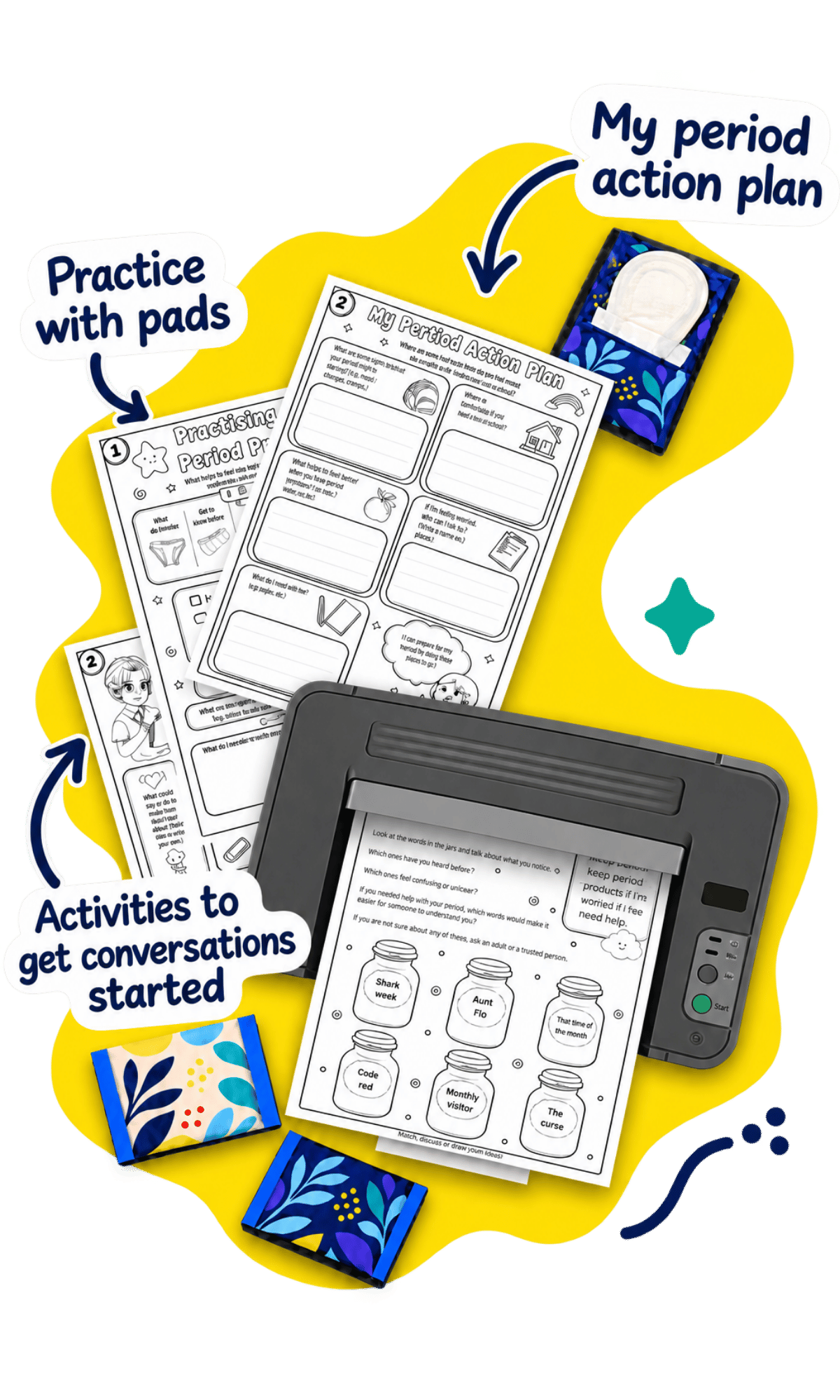
- Practise using a pad before they need one
- Put together a period kit for school and other places
- Rehearse what to do if their period starts when you’re not there
- Know who they can ask for help, and practise how to ask

How Period Ready works
Period Ready is designed for you and your child to work through together.
There are two age pathways, 7 to 10 and 11 to 14, and you get access to both. Choose the one that suits your child best, and switch if you need to.
You’ll work through seven short modules. Each has a video and a workbook activity to help you talk about, look at or practise something together.
You don’t have to work out the order of the conversations or decide what to cover next. Period Ready gives you a guided structure to follow, so you can work through the information, practical skills and preparation together.
The short format means you can do one part at a time, pause when your child has had enough and come back later.
Some children need more time to process. Some want to see something more than once. Some need to practise the same step a few times before it feels familiar.
That’s fine.
Your child doesn’t have to answer questions or talk about everything on the spot.
The aim is to make periods feel less unfamiliar before your child has to deal with one for real.
Why there isn’t a separate autism version
I haven’t made a separate “autism version” of Period Ready.
That’s a deliberate choice.
Some autistic children like having a resource that clearly says, this was made for autistic kids. That recognition can be important.
Other children don’t want something labelled that way at all.
And putting “autism-friendly” on a resource doesn’t automatically make the teaching neuroaffirming.
When I looked closely at period and sex education created for autistic children and ADHDers, I found that a lot of the difference was being reduced to simpler language, visual supports or breaking information into smaller steps.
Those things can help. But neuroaffirming teaching is about much more than that.
It means starting with the child in front of you.
- How do they learn?
- How much detail do they want?
- What do they notice in their body?
- What sensory experiences matter to them?
- How much time do they need to process?
- What happens when they’re surprised, overwhelmed or under pressure?
- Which social rules or practical steps need to be made explicit rather than assumed?
It also means teaching in a way that respects the child rather than trying to make them look or behave more neurotypical.
Period Ready is designed to be neuroaffirming and trauma-aware. It doesn’t rely on compliance, force a child through discomfort or assume that knowing something means they’ll automatically be able to use it in the moment.
And it doesn’t only teach the biology.
It makes the practical and social parts clearer too: what happens at school, who can help, what they might say, what to do if their supplies aren’t there and what happens when things don’t go according to plan.
My approach is also shaped by autistic people themselves.
I believe the best way to understand what supports autistic people is to listen to autistic people. Over the years, I’ve learned from autistic people, neurodivergent families and the children and young people I’ve worked with.
That means Period Ready isn’t built around assumptions about how autistic children should learn, communicate or behave. It’s built around what actually helps people feel understood, informed, respected and able to use the information in real life.
Neuroaffirming support should be informed by neurodivergent people, not imposed on them.
Period Ready is period education designed to be clear, explicit, practical, affirming and flexible from the beginning, with extra neurodivergent support for parents who need it.
Because the way we teach autistic children is often the way we should have been teaching all children in the first place.
Made for different kids and different families
Period Ready gives children clear, accurate, science-based information about periods, puberty and their bodies.
The biology doesn’t change depending on who your child is or how they learn.
What can change is what helps the information make sense.
One child might want more detail. Another might need things broken into smaller steps. Someone else may need to see something first, practise it more than once or come back to it later.
Sensory needs can matter too. The feel of a pad, the smell of blood, changing products, bathrooms, uniforms or wetness can all affect what feels manageable for a particular child.
Period Ready gives you room to work with the child in front of you rather than expecting every child to learn, communicate or prepare in exactly the same way.
Because everyone is different, and that’s okay. The goal isn’t to make every child learn or respond the same way. It’s to help them understand and prepare in a way that works for them.
Period Ready is also inclusive of different family structures, including single-parent, two-mum and two-dad families, and includes transgender and non-binary children without avoiding or changing the biological facts children need to understand periods.
The facts stay the same. How we help children understand them can change.
And Period Ready is there when new questions come up
Period Ready isn’t only a course you complete once.
After you’ve worked through the preparation together, it stays available for your child to come back to when they need a reminder, want to see something again or have a new question.
Some children ask questions straight away. Others need more time to process and come back days or weeks later.
That’s okay too.
They can:
- Rewatch the course videos
- Return to their workbook and printables
- Watch practical how-to videos when they need to see something again
- Use the Period Help Desk to ask period questions
- Send Cath a question and watch the answer videos she adds
It gives your child somewhere designed for them to look for answers rather than having to search the internet and work out which information to trust.
You can prepare for what they need now, knowing there’s somewhere reliable to come back to for clear, age-appropriate period information when new questions come up.
They don’t have to remember everything the first time. And you don’t have to have every answer ready yourself.
What “prepared” can look like
Your child is at school. They go to the bathroom and notice blood.
For a moment, they might be surprised.
But this isn’t the first time they’ve thought about what to do.
They know it could be their period. They’ve practised using a pad. They know where their period kit is and who they can ask for help.
If the kit isn’t there, they’ve practised a backup plan for that too.
Knowing something at home, when everything is calm, can feel very different from needing to use it at school when something unexpected has happened.
Your child might need more time to process. They might forget a step. They might find it harder to ask for help in the moment.
That doesn’t mean the preparation hasn’t worked.
The goal isn’t perfect performance. It’s giving them something familiar to fall back on.
They’ve been here before, in practice.
Preparation doesn’t have to mean one big period talk
You don’t have to sit your child down and explain everything at once.
Period Ready breaks the preparation into smaller pieces you can work through together.
Watch a short video. Use the workbook to talk about it. Practise something. Stop there if that’s enough for today.
Some children need more time to process what they’ve heard. Some want to think about it before they respond. Some do better coming back to the same idea more than once.
Your child doesn’t have to answer questions on the spot, finish the activity in one go or be ready to talk every time you are.
Come back tomorrow, next weekend or whenever they’re ready for the next part.
There’s no prize for getting through it quickly. The goal is for your child to understand and practise what they’ll need.
What you get inside Period Ready
The videos, workbook and practical activities you use to prepare together.
Get ready together
Seven guided modules, with short videos and a workbook, help your child:
- Understand what periods are and why they happen
- Learn about the body changes that can happen before a first period
- Explore period products and practise using a pad
- Decide what they’ll need in their period kit
- Rehearse what to do if their period starts away from home
- Practise backup plans for leaks, no products or other unexpected situations
- Work out who they can ask for help and what they could say
There are worksheets, checklists and practical activities along the way, so you’re not left wondering what to talk about or practise next.
You follow the program. Period Ready guides you through the preparation.
There’s support for you too
Period Ready isn’t only about what your child needs.
Inside the Parent Hub, you’ll find guidance to help you set everything up and support your child as you go.
That includes help choosing the right age pathway, setting up your child’s access, getting the workbook and supplies ready, and additional information for parents.
There’s also dedicated neurodivergent support to help you adapt the preparation for the child in front of you.
That might mean thinking about:
- sensory needs around blood, pads, period pants, smells, wetness or bathrooms
- whether your child needs more detail, clearer steps or more repetition
- processing time
- body signals they may notice early, late or not very clearly
- remembering supplies and period-care routines
- what might make asking for help harder
- which practical or social steps need to be made more explicit
It can also mean looking at what happens when your child is overwhelmed, goes quiet, gets stuck or can’t access a skill they understood perfectly well at home.
The aim isn’t to make your child behave more typically. It’s to work out what makes the information and skills more accessible for them.
You don’t need to decide which of these “fits” your child before you start. They’re things to notice and explore as you work out what helps your child feel more prepared.
And you don’t need to be a period expert. Period Ready gives you somewhere reliable to look for answers when you need them.
There’s also parent-only support around sex and reproduction, so you have somewhere to turn when period conversations lead to bigger questions.
Why I created Period Ready
I’m Cath Hakanson, a sexual health nurse, sex educator and mum. I’ve spent more than 30 years working in sexual health and helping parents talk about and teach sex education in clear, practical ways.
I’m also an autistic ADHDer, and I’ve raised two neurodivergent kids.
I was late diagnosed, and looking back now, I can see my autism all through the way I’ve taught sex education for years.
I notice the vague bits. The hidden steps. The things adults sometimes assume a child will just know. I tend to make those things explicit, give more detail when it helps and expect questions to come later.
I also know that understanding something once doesn’t always mean it will be easy to use when the moment is unexpected, stressful or sensory-heavy.
My own lived experience matters, but this work isn’t based on me alone. It’s also shaped by what I’ve learned from autistic people, neurodivergent families and decades of working with children and parents around bodies, sexuality and growing up.
Over the years, I’ve heard the same worries from children again and again.
That’s why I created Period Ready.
I wanted children to have clear, accurate, science-based information, but I also wanted them to have the chance to see, practise, repeat and come back to things.
And I wanted parents to have a guided way to do that preparation without having to invent every conversation and activity themselves.
- To open a pad before they need one.
- To work out what goes in their period kit.
- To think through who they could ask for help.
- To rehearse what happens if things don’t go according to plan.
Because knowing about periods matters. Knowing what to do matters too.
What families are saying
“I had been dreading this conversation because I didn’t know how to start it without making it awkward. Period Ready made it so much easier. We actually worked through it together over a weekend and it felt really guided and manageable. My daughter even enjoyed parts of it, which I never expected.”
“I thought my daughter might feel embarrassed or uncomfortable, but she was actually calm and really engaged. Practising things like using a pad and putting together a period kit made it feel normal instead of awkward. The rehearsal part made such a difference compared to just talking about it.”
Get Period Ready together
Accurate information, practical preparation and a way to learn that works for your child.
Period Ready includes
- Both age pathways: 7 to 10 and 11 to 14
- Seven guided modules
- Guided workbook and practical activities
- Period product practice
- First-period preparation and rehearsal
- Practical how-to videos
- Printables and checklists
- Period Help Desk
- Ask Cath + answer videos
- Parent Hub
- Neurodivergent support
- Lifetime family access
Is Period Ready right for your child?
Period Ready is for parents and carers of children aged 7 to 14 who are preparing for their first period, or who have recently started and still need some help working out what to do.
It can be especially useful if your child:
- likes knowing what to expect before something new happens
- wants more detail than a quick explanation gives them
- needs to see something before they feel ready to do it
- does better with clear steps or smaller chunks of information
- benefits from repetition or coming back to the same idea more than once
- has sensory concerns about pads, period pants, blood, wetness, smells or bathrooms
- may notice body signals early, late or not very clearly
- finds it hard to remember supplies or the steps in a routine
- knows how to ask for help in theory, but may find it harder in the moment
- can get stuck when something unexpected happens
- is autistic, an ADHDer or otherwise neurodivergent and you want period preparation that can be adapted around the child in front of you
You don’t need to know exactly when their first period will start.
And your child doesn’t need to fit every point on this list.
You can start with what’s useful now and adapt the rest as you go.
What Period Ready isn’t
Period Ready isn’t a course you hand to your child and expect them to work through alone.
The preparation part is designed for you to do together, so you can adjust the pace, detail, repetition and practical support to suit your child.
Once you’ve worked through it, Period Ready stays available for your child to return to when they need a reminder or have a new question.
Frequently asked questions
Is Period Ready suitable for autistic children and ADHDers?
Yes.
Period Ready gives children the same clear, accurate information about periods, but it allows for different ways of learning and preparing.
You can pause, repeat things, add more detail or take more time depending on what works for your child.
The Parent Hub also includes extra neurodivergent support around sensory needs, processing, routines, body signals, help-seeking and practical preparation.
What makes Period Ready neuroaffirming?
Neuroaffirming teaching is about more than using simple language or breaking things into steps.
Period Ready starts with the child in front of you. It gives you room to consider how they learn, process, communicate, experience sensory input and use information when they’re stressed or surprised.
It also makes practical and social steps more explicit rather than assuming children will simply pick them up.
The aim isn’t to make an autistic child or ADHDer look more neurotypical. It’s to help them understand, prepare and access support in ways that work for them.
Is Period Ready trauma-aware?
Yes.
Period Ready is designed to keep preparation low-pressure and respectful.
Your child doesn’t have to answer on the spot, push through sensory distress or complete an activity just because it has been started.
You can pause, come back later and adapt the way you work through the course.
The focus is on helping your child feel informed and prepared, not compliant.
What if my child has sensory worries about periods?
Sensory needs can be part of period preparation.
Your child may have strong preferences around pads, period pants, blood, smells, wetness, bathrooms or clothing.
Period Ready gives you opportunities to explore products and practise before they need them, and the Parent Hub includes support to help you think through sensory needs without assuming your child simply has to tolerate something that feels awful.
What if my child notices body signals late, or not very clearly?
That can happen.
Period Ready doesn’t rely on your child noticing the “right” body signal at the right time.
You can teach practical steps, routines and backup plans ahead of time, so they have something external to fall back on as well.
What if my child knows what to do but freezes or gets stuck in the moment?
Knowing a step when everything is calm isn’t always the same as being able to use it when something unexpected happens.
That’s one reason Period Ready includes rehearsal.
Your child can practise products, school situations, asking for help and backup plans before they actually need them.
The goal isn’t perfect performance. It’s familiarity and having a route forward when the moment is messy.
Do I need to know much about periods myself?
No. You don’t need to be the expert.
The videos and workbook guide you through what to talk about and practise together, and the Parent Hub gives you extra information when you need it.
If your child asks something you don’t know, you can find the answer inside Period Ready rather than having to come up with it on the spot.
Your child can also use the Period Help Desk and Ask Cath when new questions come up.
Can my child use Period Ready to look things up themselves?
Yes.
After you’ve worked through the preparation together, Period Ready stays available as a reliable period resource your child can return to.
They can rewatch videos, use the practical how-to resources, return to printables, use the Period Help Desk and send Cath a question.
That gives them somewhere designed for them to find clear, age-appropriate information rather than having to search the internet and work out which answers to trust.
Is it too early to start?
You don’t need to wait until you think a first period is about to happen.
Having time to learn and practise without urgency can make preparation easier.
Start with what’s useful for your child now. You can pause, come back and repeat things whenever you need to.
What if my child has already started their period?
Period Ready can still be useful if their period has recently started and they’re learning how to manage it.
They can practise products, work through school and away-from-home situations, build their kit and return to Period Ready when questions come up.
Is it only for girls?
No.
Period Ready is for children who have periods or may have periods. It’s inclusive of transgender and non-binary children and different family structures, while still giving children clear, accurate, science-based information about bodies and periods.
Does Period Ready talk about sex?
The child course focuses on periods and the information children need to understand them.
There is additional parent-only information about sex and reproduction so you have support if those questions come up.
What if my child doesn’t want to talk about periods?
You don’t have to force one big conversation.
You can keep sessions short, watch a video together, use the workbook or practise one practical skill and stop there.
You can return when your child is ready for more.
Can my child ask Cath a question?
Yes.
Children can send Cath a question through Period Ready, and Cath adds answer videos for children to watch.
What do we need before we start?
You can access Period Ready online from your phone, tablet or computer.
You’ll need the workbook, plus a few basic supplies for the practical activities.
The Parent Hub helps you get everything organised before you begin.
What if I have more than one child?
Your purchase includes lifetime family access, so you can use Period Ready with siblings too.
You receive both age pathways and can choose the one that best fits each child.
Try Period Ready for 30 days
You can work through Period Ready with your child and see whether it works for your family.
If you decide it isn’t right for you, just let me know within 30 days and I’ll refund your purchase.